Beyond Temporal Difference: Scaling Reinforcement Learning with Divide and Conquer
Reinforcement learning (RL) has achieved remarkable successes, yet many algorithms still struggle when tasks require reasoning over long time horizons. The standard workhorse—temporal difference (TD) learning—often falters under these conditions due to error accumulation through bootstrapping. This article explores an emerging alternative paradigm based on divide and conquer, which promises better scalability without relying on TD updates.
Understanding Off-Policy Reinforcement Learning
Before diving into the new approach, it's essential to clarify the problem setting: off-policy RL. In RL, algorithms fall into two broad categories:
- On-policy RL: Only data collected by the current policy can be used for updates. Older experience must be discarded after each policy change. Examples include PPO, GRPO, and policy gradient methods.
- Off-policy RL: Any data—whether from past policies, human demonstrations, or even internet logs—can be reused. This flexibility makes off-policy RL more general but also more challenging. Q-learning is the most famous off-policy algorithm.
Off-policy RL is especially valuable when data collection is expensive, such as in robotics, dialogue systems, or healthcare. The ability to leverage diverse data sources can dramatically improve sample efficiency. As of 2025, on-policy methods have mature scaling recipes, but a truly scalable off-policy algorithm that copes with complex, long-horizon tasks remains elusive.
The Challenges of Temporal Difference Learning
Most off-policy RL algorithms train a value function using TD learning. The classic Bellman update for Q-learning is:
\[ Q(s, a) \gets r + \gamma \max_{a'} Q(s', a') \]
The core issue is bootstrapping: the error in the next state's value Q(s', a') propagates back to the current state. Over many steps, these errors accumulate, making it difficult for TD learning to scale to tasks with long horizons. For a deeper explanation, see this detailed post on error propagation.
To mitigate this, practitioners often mix TD with Monte Carlo (MC) returns. For instance, n-step TD learning uses actual rewards for the first n steps and then bootstraps from that point:
\[ Q(s_t, a_t) \gets \sum_{i=0}^{n-1} \gamma^i r_{t+i} + \gamma^n \max_{a'} Q(s_{t+n}, a') \]
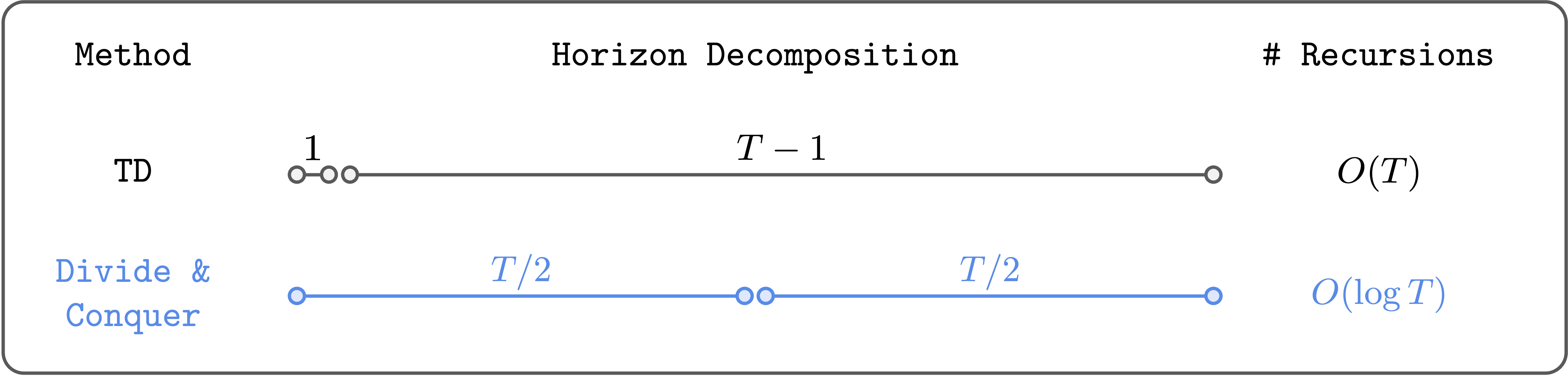
By reducing the number of bootstrapping steps, error propagation is less severe. In the limit (n = infinity), this becomes pure MC learning—no bootstrapping at all. While this hybrid approach works reasonably well, it remains unsatisfying. It doesn't fundamentally address the structural weakness of TD for long horizons; it merely trades off bias and variance.
A Fresh Approach: Divide and Conquer in RL
An alternative paradigm eschews TD learning entirely. Instead, it reframes the RL problem using divide and conquer. The core idea is to break a long-horizon task into shorter, more manageable subproblems, solve each subproblem independently, and then combine the solutions. This avoids the error accumulation inherent in bootstrapping over many time steps.
How does it work in practice? One implementation learns a goal-conditioned value function that estimates the ‘distance’ between any state and a goal. By decomposing the original goal into a sequence of intermediate subgoals (perhaps using a separate high-level planner), the agent can solve each segment using a short-horizon policy. The short horizon means TD errors have limited chance to propagate, and the divide-and-conquer structure makes the overall problem much more tractable.

This approach aligns with the natural structure of many real-world tasks. For example, navigating a robot across a building can be broken into ‘move to the hallway’, ‘go to the elevator’, ‘ascend to floor 2’, etc. Each subgoal is reachable with a simple policy, and errors do not cascade across segments.
Why This Matters for Practical Applications
The divide-and-conquer paradigm is not merely a theoretical curiosity—it has direct implications for domains where TD learning struggles:
- Robotics: Long-horizon manipulation or navigation tasks become more feasible without delicately tuned discount factors or multi-step returns.
- Dialogue systems: Conversational agents that must maintain coherent context over many turns can benefit from subgoal decomposition.
- Healthcare: Treatment planning over extended periods can be broken into phases, each optimized separately.
Because off-policy data (including demonstrations) can be naturally segmented into subgoal sequences, this paradigm is highly data-efficient. It also simplifies credit assignment: rewards are attributed to the subgoal that directly influences them, rather than being backpropagated through a long chain of bootstrapped values.
Future Directions and Open Questions
While promising, the divide-and-conquer approach is not a panacea. Key challenges include:
- How to automatically discover meaningful subgoals without manual engineering?
- How to ensure that solving subproblems independently leads to globally optimal behavior?
- How to integrate with continuous action spaces and high-dimensional observations?
Nonetheless, as the RL community seeks algorithms that can handle increasingly complex and extended tasks, moving beyond TD learning may become essential. The combination of divide-and-conquer with modern function approximation (e.g., neural networks) opens up a rich space for future research.
In summary, while TD learning has been the backbone of off-policy RL for decades, its scaling limitations motivate exploring alternative paradigms. Divide and conquer offers a natural, error-resistant framework for long-horizon problems. By breaking tasks into subtasks and learning short-horizon policies, this approach may unlock new levels of performance in sample-efficient and real-world RL.
Related Articles
- The Book That Built a Generation: How 101 BASIC Computer Games Sparked the Home Computer Revolution
- How to Pre-Configure Grafana Assistant for Instant Infrastructure Awareness
- Navigating Tax Obligations in Retirement: Two Essential Rules New Retirees Must Understand
- 6 Critical Improvements from Cloudflare's 'Code Orange: Fail Small' Project
- New Framework Reveals: Design Teams Thrive When Leaders Embrace Overlap, Not Separation
- Revolutionizing Large Language Models with TurboQuant: Advanced Compression for KV Cache and Vector Search
- Cloudflare Unveils 'Agent Readiness' Score: Critical Alert for Website Owners Facing AI-Driven Future
- What John Ternus as Apple CEO Means for Hardware Enthusiasts