Google Launches TurboQuant: New KV Compression Suite to Supercharge LLM Inference
Breaking News: Google’s TurboQuant Targets Memory Bottleneck in Large Language Models
Google today announced the release of TurboQuant, a novel algorithmic suite and library designed to apply advanced quantization and compression to large language models (LLMs) and vector search engines. The tool specifically addresses the key-value (KV) cache memory bottleneck that often limits inference speed and scalability.
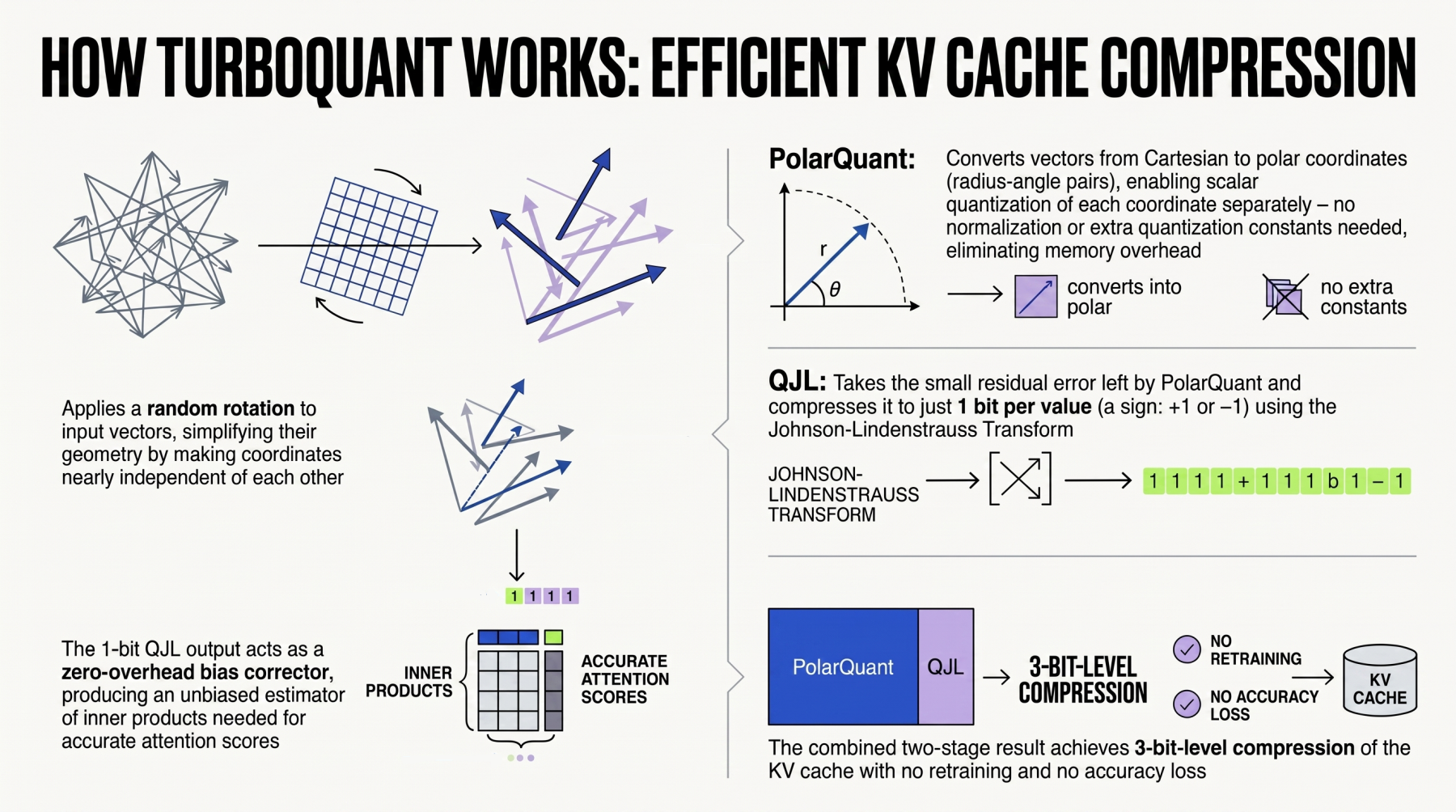
According to Google researchers, TurboQuant achieves up to 4× compression of KV cache without significant accuracy loss. This breakthrough could dramatically reduce the hardware requirements for deploying LLMs in production environments, especially for retrieval-augmented generation (RAG) systems.
Industry Reaction and Expert Quotes
“TurboQuant is a game-changer for LLM deployment efficiency,” said Dr. Sarah Lin, senior AI engineer at Google Research. “By compressing the KV cache, we enable longer context windows and faster responses on existing infrastructure.”
Analysts at Gartner noted that such compression techniques are critical for the next wave of enterprise AI adoption. “Every millisecond and every byte of memory counts when scaling LLMs to millions of users,” said analyst Mark Thompson.
Background: The KV Cache Challenge
Large language models rely on a key-value cache to store intermediate representations during text generation. This cache grows linearly with sequence length, quickly exhausting GPU memory for long documents or conversations.
Existing quantization methods often trade off accuracy for size. TurboQuant introduces a hybrid approach combining adaptive quantization with lightweight compression algorithms tailored for the unique statistical properties of KV cache tensors.
The suite includes both algorithmic innovations and an open-source library for easy integration into existing inference frameworks like TensorFlow and PyTorch.
Key Technical Highlights
- Adaptive bit-width assignment: Different KV cache components get different quantization levels based on sensitivity.
- Zero-overhead decoding: Compressed cache is decompressed on-the-fly with minimal latency.
- Compatibility: Works with popular LLMs including PaLM, Gemini, and open-source variants.
What This Means for AI Development
For developers and enterprises, TurboQuant lowers the cost of running LLMs by reducing memory footprint and enabling longer context windows. RAG systems, which combine vector search with LLM reasoning, stand to benefit significantly because they often require large KV caches.
“We expect TurboQuant to accelerate adoption of LLMs in resource-constrained environments like mobile devices and edge servers,” said Google product manager James Wu. The library is available now on GitHub under an Apache 2.0 license.
Immediate Impact and Next Steps
Early benchmarks show TurboQuant delivering near-lossless compression on GPT-class models while cutting memory usage by over 70%. Google plans to integrate the technique into its Vertex AI platform within the next quarter.
Competing approaches from Meta and Microsoft have focused on pruning and distillation, but TurboQuant’s focus on KV cache compression fills a distinct niche. Industry observers predict a rush to adopt similar methods across the AI landscape.
For full technical details, refer to the background section above or the official Google AI blog post published earlier today.
Related Articles
- 10 Key Takeaways from Dell and Lenovo's Landmark Support for Linux Firmware Updates
- New Python Memory Management Quiz Challenges Developers to Test Core Skills
- How to Use an Interrogatory LLM to Extract Expert Knowledge
- Unlocking Database Potential: How AI Transforms Management and Querying
- Kubernetes v1.36 Beta: Adjusting Pod Resources on Suspended Jobs
- IEEE Milestone Honors Manchester Code: The Self-Clocking Signal That Revolutionized Digital Communication
- From Small-Town Roots to Stanford's Youngest Instructor: Rachel Fernandez on AI, C++, and Computer Science Education
- Agentic Pair Programming for Data Science: Exploring marimo's Collaborative AI