10 Milestones in NASA's Next-Generation Martian Rotorcraft Development
When NASA's Ingenuity helicopter took its first flight on Mars in 2021, it revolutionized planetary exploration. Now, engineers at the Jet Propulsion Laboratory (JPL) are building on that triumph to create more advanced rotorcraft capable of carrying heavier payloads across greater distances. This listicle highlights ten critical developments and facts about the next chapter in Martian aviation.
1. Ingenuity's Historic Mars Debut
Ingenuity made history as the first airborne platform to operate on another world. Launched with the Perseverance rover in 2020, the dual-bladed helicopter not only proved flight was possible in Mars's thin atmosphere but also demonstrated a new way to explore. Its success opened the door for future rotorcraft missions that could revolutionize how we study the Red Planet.
2. Exceeding All Expectations
NASA initially set a modest goal of five flights over 30 days for Ingenuity. But the helicopter vastly overachieved, completing 72 flights before its mission ended. This performance validated the durability of small, autonomous aircraft in extreme conditions and provided invaluable data for designing next-generation models.
3. The Final Flight and Crash-Landing
Ingenuity's mission concluded with a crash-landing in January 2024. While the rotorcraft was damaged beyond repair, its final moments offered crucial insights into landing dynamics and system failures. Engineers at JPL are using this data to improve landing gear and navigation algorithms for future rotorcraft.
4. A New Paradigm for Exploration
Ingenuity showed that rotorcraft can access areas ground rovers cannot, like steep cliffs, craters, and lava tubes. This ability to fly over obstacles and cover longer distances makes airborne platforms ideal for searching for signs of past life or collecting samples from diverse terrain.
5. The SkyFall Mission: Three Helicopters to Mars
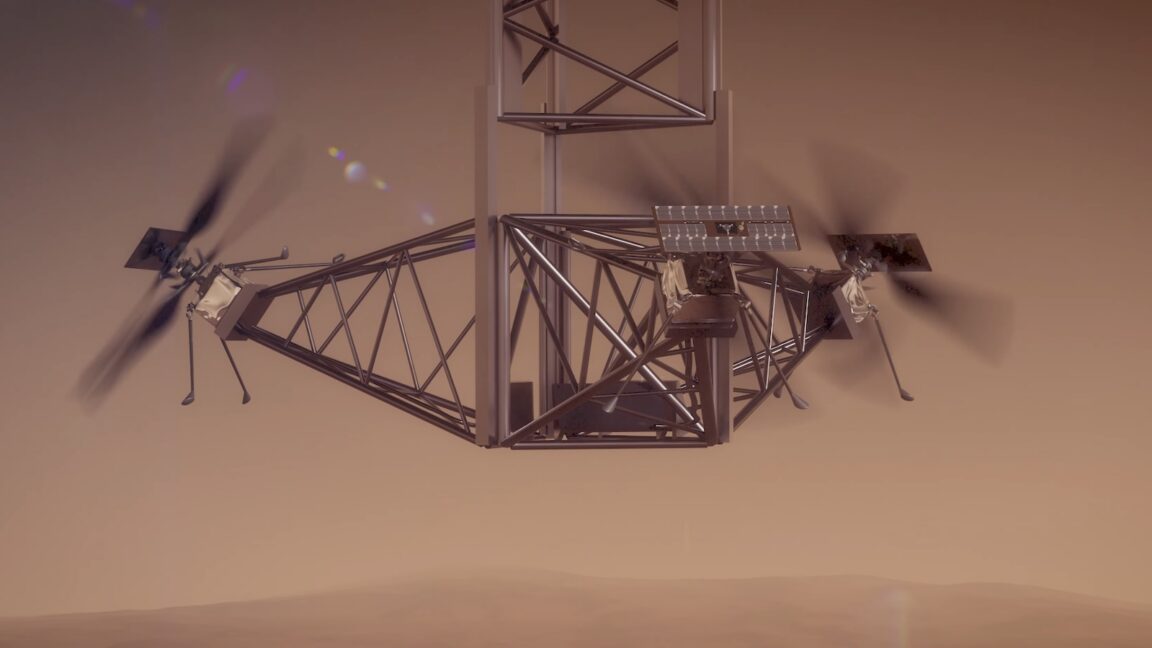
NASA is planning to send three upgraded helicopters to Mars under the SkyFall mission. These rotorcraft will be larger and more capable than Ingenuity, designed to work together and support both scientific research and future human exploration. SkyFall represents a major step in establishing a persistent aerial presence on Mars.
6. Launch Timeline and Spacecraft
SkyFall could launch as early as late 2028, riding aboard a nuclear-powered spacecraft called Space Reactor-1 (SR-1). This tech demo initiative, announced by NASA Administrator Jared Isaacman, will test advanced propulsion systems while delivering the rotorcraft to Mars. The tight timeline reflects the project's high priority.
7. Nuclear Power for Deep Space Travel
The SR-1 spacecraft uses a nuclear thermal propulsion system, which could significantly shorten travel time to Mars. This technology is part of NASA's broader push to enable faster, more efficient crewed missions. For SkyFall, it ensures the helicopters arrive at the Red Planet with minimal delay and maximum payload capacity.
8. JPL's Next-Generation Rotorcraft Design
Engineers at JPL are developing rotorcraft with larger blades, more powerful motors, and improved energy storage. These designs are tailored to Mars's low-density atmosphere (about 1% of Earth's), requiring blades that spin faster and generate more lift. Testing in specially designed vacuum chambers has validated key performance metrics.
9. Heavier Payloads, Longer Distances
Unlike Ingenuity, which carried only a color camera and a few sensors, the next-generation rotorcraft are built to ferry science instruments up to 5 kilograms across tens of kilometers. This capability will allow researchers to deploy seismometers, spectrometers, and sample-collection tools in remote locations.
10. Overcoming the Low-Density Atmosphere
Mars's thin atmosphere presents a major challenge: rotor blades produce less lift than on Earth. JPL's breakthrough includes optimized blade shapes and higher RPMs, combined with lightweight composite materials. These innovations ensure stable flight even in the planet's rarefied air, paving the way for routine aerial exploration.
From Ingenuity's first flight to the ambitious SkyFall mission, NASA's rotorcraft program is pushing the boundaries of what's possible on Mars. Each milestone brings us closer to a future where helicopters and other flying machines become standard tools for planetary science, opening up new frontiers for discovery. The hard work at JPL is just beginning.
Related Articles
- Voyager 1 Powers Down 50-Year-Old Instrument to Conserve Energy in Deep Space
- TikTok Gang Content Unveils New Tool for Law Enforcement, Cincinnati Study Finds
- How to Spot the Best Sky Events in May 2026
- How a Pair of Mismatched Exoplanets Found Stability After Travelling Inward from the Cold
- Consciousness May Be Universe's Deepest Layer, New Theory Proposes
- 5 Surprising Connections Between Venus and Hawaii's 2022 Eruption
- Charred and Proud: The Artemis 2 Orion Capsule's Fiery Return from the Moon
- Exploring the Iconic Heroes and Villains of Masters of the Universe