Qualcomm's Premium Snapdragon 8 Elite Gen 6 Pro: A $300 Chip That Could Redefine Flagship Pricing
Introduction
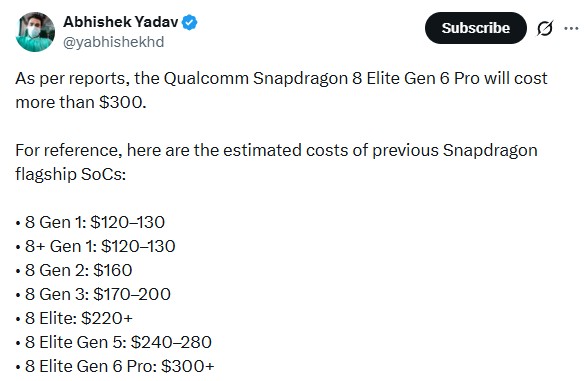
Qualcomm is preparing to launch its next-generation flagship mobile processor, the Snapdragon 8 Elite Gen 6 Pro, which is rumored to cost smartphone manufacturers over $300 per chip. If true, this would make it the most expensive mobile processor in Qualcomm's history, potentially driving up the prices of premium Android flagships. The leak, shared by tipster Abhishek Yadav on X, includes a breakdown showing a steady increase in the cost of Qualcomm's high-end silicon over recent years.

The Cost Evolution of Qualcomm's Flagship Chips
According to the leaked data, Qualcomm's flagship Snapdragon chips have seen a consistent price hike with each generation. For instance, the Snapdragon 8 Gen 1 launched at around $120, while the Snapdragon 8 Gen 2 jumped to $160, followed by the Snapdragon 8 Gen 3 at $200, and the Snapdragon 8 Elite (Gen 4) at $220. The rumored Snapdragon 8 Elite Gen 6 Pro at over $300 represents a significant leap, far exceeding the previous cost trends. This escalation reflects both the increasing complexity of chip design and the adoption of advanced fabrication nodes from TSMC.
A Split Lineup: Standard vs Pro
The next flagship series appears to be diverging into two distinct tiers: a standard Snapdragon 8 Elite Gen 6 and a Pro variant. The Pro chip, as the name suggests, is aimed at Ultra-tier Android phones—devices that already carry premium price tags. This segmentation allows Qualcomm to cater to different market segments while maximizing revenue from its top-tier technology. The standard version is expected to be more affordable but still offer high performance, while the Pro will push the boundaries of mobile computing at a steep cost.
Technical Specifications of the Snapdragon 8 Elite Gen 6 Pro
The rumored specifications of the Pro chip are impressive:
- Manufacturing Process: TSMC's 2nm (N2) process node, delivering significant improvements in power efficiency and transistor density.
- GPU: An all-new Adreno 850 GPU, promising higher graphics performance for gaming and AI workloads.
- Cache: A larger L3 cache (potentially 8MB or more) to reduce memory latency and improve responsiveness.
- Memory Bandwidth: Wider memory bus (256-bit or beyond) to support faster data transfer between the CPU, GPU, and RAM.
- RAM Support: LPDDR6 RAM, offering higher speeds and lower power consumption compared to LPDDR5X.
These enhancements are critical for AI on-device processing, real-time ray tracing in mobile games, and high-resolution video recording. However, they also contribute to the chip's soaring cost.
Impact on Smartphone Pricing
If smartphone makers pay over $300 per chip—one of the most expensive components in a phone—they will likely pass that cost onto consumers. Flagship phones already retail for $1,000 or more, so a chip price exceeding $300 could push top-tier models beyond the $1,500 mark. For example, a phone like the Samsung Galaxy S26 Ultra or Xiaomi 16 Ultra might see a $100-$200 price increase over their predecessors. Mid-range flagships that opt for the standard Snapdragon 8 Elite Gen 6 may remain relatively more affordable, but the overall market could split into two tiers: premium and ultra-premium.
What This Means for Consumers
For consumers, the rising cost of flagship chips translates to higher purchase prices and potentially narrower value propositions. While the Pro chip will deliver cutting-edge features, most users may not need the additional performance. However, those who demand the best possible camera processing, gaming, and AI capabilities will have to pay a premium. On the bright side, increased competition from MediaTek and Apple may push Qualcomm to justify these costs through superior performance and efficiency gains.
Conclusion
Qualcomm's rumored Snapdragon 8 Elite Gen 6 Pro represents a bold step toward even more powerful mobile computing, but it comes at a price. The $300+ cost to OEMs signals that the era of affordable flagship chips may be fading, replaced by a segmented market where only the most expensive phones benefit from the absolute latest technology. As we approach the expected release in late 2025, it's worth watching how manufacturers balance performance and pricing to retain their customer base.
Related Articles
- LangChain Agents Go Mainstream: 57% of Companies Now Deploy AI Agents in Production, Report Reveals
- Lenovo ThinkPad X13 Gen 7: Lighter Than Ever with Intel Panther Lake and AMD Ryzen AI PRO 400 Options
- Preparing Linux for AMD CPPC HighestFreq: A Hands-On Guide
- 7-Eleven’s Summer Slurpee Deal: How to Enjoy $1 Frozen Drinks and More
- Decoding the Alienware 15: A Budget Gaming Laptop with Last-Gen Hardware and Mainstream Appeal
- Lenovo ThinkPad X13 Gen 7: Everything You Need to Know About Its Latest Spec Upgrade
- Balancing the AI Compute Equation: AMD’s Hybrid Silicon Strategy and the Agent Paradox
- 5 Key Insights from Michael Dell's 2026 Dell Technologies World Keynote