Self-Improving AI Agents: Hermes and the Power of Local Hardware
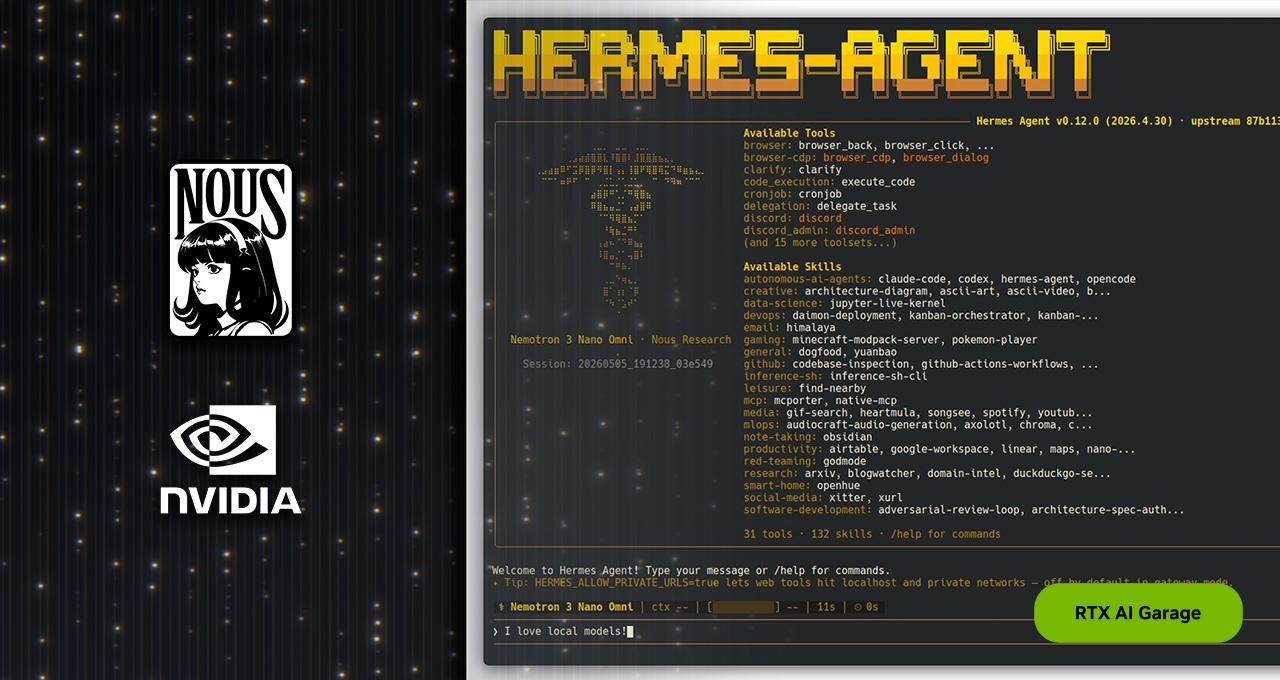
Hermes Agent, developed by Nous Research, represents a breakthrough in agentic AI, combining self-improvement capabilities with local execution on NVIDIA hardware. With over 140,000 GitHub stars in less than three months and recognition as the most used agent on OpenRouter, Hermes is reshaping how users approach automated tasks. Its design prioritizes reliability and adaptability, running seamlessly on NVIDIA RTX PCs, RTX PRO workstations, and DGX Spark. Complemented by Alibaba's Qwen 3.6 models, which deliver data-center-level intelligence on consumer hardware, Hermes offers a powerful, always-on assistant that learns and evolves without requiring cloud dependency.
What Is Hermes Agent and Why Is It Gaining Popularity?
Hermes Agent is an open-source framework developed by Nous Research that enables self-improving AI agents to operate locally. It crossed 140,000 GitHub stars in under three months and, according to OpenRouter, became the most used agent globally. Its popularity stems from two historically challenging qualities: reliability and self-improvement. Unlike many agentic frameworks that require constant debugging or cloud connectivity, Hermes is provider- and model-agnostic, optimized for always-on local use. This makes it ideal for running on NVIDIA RTX PCs, RTX PRO workstations, and DGX Spark, which provide the necessary processing power for 24/7 operation. The agent integrates with messaging apps, accesses local files and applications, and performs tasks autonomously, making it a practical tool for both developers and everyday users. Its success reflects a growing demand for AI that can be trusted to work consistently without external dependencies.
How Does Hermes Achieve Self-Improvement?
Hermes’s self-improvement capability is driven by a feature called self-evolving skills. When the agent encounters a complex task or receives feedback, it saves its learnings as a reusable skill. Over time, it writes and refines these skills, adapting to new challenges without manual intervention. For example, if Hermes learns a more efficient way to organize files or respond to queries, it incorporates that knowledge into its skill set. This process ensures the agent becomes more capable and accurate with each interaction. The framework also curates and stress-tests every skill, tool, and plug-in before inclusion, maintaining reliability. Unlike typical agents that execute tasks in isolation, Hermes treats each skill as a building block that evolves, leading to continuous performance gains. This design is particularly effective for local models, as it allows the agent to operate with smaller context windows while learning from past experiences.
What Are Contained Sub-Agents and How Do They Improve Performance?
Hermes uses a unique approach to managing complex tasks by employing contained sub-agents. These are short-lived, isolated workers dedicated to specific sub-tasks, each with a focused context and set of tools. This organization keeps task decomposition tidy and minimizes confusion for the main agent. By limiting each sub-agent’s scope, Hermes can run with smaller context windows, which is particularly advantageous for local models with limited memory. For instance, if a task involves fetching data from a website, processing it, and formatting a report, Hermes spawns a sub-agent for each step, ensuring that only relevant information is in focus. This reduces cognitive load on the primary model and accelerates execution. The isolation also prevents errors in one sub-task from cascading, enhancing overall reliability. This design is a key reason why Hermes outperforms other frameworks when using identical models, as it optimizes resource usage while maintaining accuracy.
How Does Hermes Ensure Reliability Even on Local Models?
Reliability is a cornerstone of Hermes, achieved through meticulous curation and testing by Nous Research. Every skill, tool, and plug-in shipped with the framework undergoes stress-testing to ensure consistent behavior. This results in an agent that “just works,” even with 30-billion-parameter-class local models, without the constant debugging required by many alternatives. The framework acts as an active orchestration layer rather than a thin wrapper, enabling persistent, on-device agents instead of task-by-task execution. By isolating sub-agents and refining skills, Hermes reduces error propagation and maintains stability over long-running operations. Additionally, because the agent runs locally, it avoids latency issues and network dependencies that can disrupt cloud-based solutions. This reliability is crucial for users who depend on always-on assistants for productivity, such as managing files, automating repetitive tasks, or integrating with messaging apps. The combination of rigorous testing and thoughtful architecture makes Hermes a dependable choice for both beginners and experts.

How Does Hardware Quality Affect Hermes’s Performance?
Since both Hermes and the underlying language model run locally, the quality of hardware directly determines user experience. NVIDIA RTX GPUs are purpose-built for AI workloads, offering high memory bandwidth and specialized tensor cores that accelerate inference. For example, running a 30-billion-parameter model like Qwen 3.6 35B requires roughly 20GB of memory, which is well within the capability of NVIDIA RTX 40-series GPUs and RTX PRO workstations. In contrast, older or less powerful hardware may struggle with response times or model size. The NVIDIA DGX Spark, with its optimized architecture, provides an even more robust platform for around-the-clock operation. Faster hardware translates to quicker task execution, smoother multitasking, and the ability to run larger models without compromising speed. Users with high-end RTX PCs experience near-instantaneous responses, while those on modest setups may see slower but still functional performance. This hardware-software synergy is a key reason why Nous Research recommends NVIDIA platforms for the best Hermes experience.
What Are Qwen 3.6 Models and How Do They Benefit Local AI?
Qwen 3.6 is a series of high-performance, open-weight large language models from Alibaba, specifically designed to enhance local AI agents like Hermes. The two primary variants—27B and 35B parameters—outperform their predecessors (120B and 400B parameter models) in accuracy while using significantly less memory. For instance, the 35B model runs on roughly 20GB of RAM, compared to 70GB+ required by older 120B models, making it accessible on consumer GPUs. This efficiency is achieved through architectural improvements that increase active parameters per inference, yielding smarter outputs without bloating resource usage. On NVIDIA RTX GPUs, these models can run at full speed, providing data-center-level intelligence locally. For Hermes users, Qwen 3.6 means they can run a highly capable AI assistant on a single PC, avoiding cloud costs and latency. The models are ideal for tasks requiring deep reasoning, such as coding assistance, document analysis, and complex decision-making, all within a private, always-on environment.
Why Is Local AI with Hermes and NVIDIA a Game Changer?
Local AI, as embodied by Hermes on NVIDIA hardware, transforms how individuals and organizations use artificial intelligence. By keeping all processing on-device, users gain privacy—no data leaves their machine—and autonomy—no reliance on internet connectivity or cloud service uptime. Hermes’s self-improving skills and reliability ensure that the agent becomes more valuable over time, adapting to personal workflows. The combination with NVIDIA RTX GPUs provides the horsepower needed for sophisticated models like Qwen 3.6, which rival cloud-based LLMs in capability. This setup is especially powerful for professionals who need an always-on assistant for coding, research, or creative work, without the overhead of API costs or data transmission. Moreover, the open-source nature encourages community contributions, rapidly expanding skills and tools. As hardware continues to improve, local AI agents could become as commonplace as personal computers, offering a personalized, secure, and efficient alternative to centralized AI services.
Related Articles
- Navigating Your First Kotlin Open-Source Contribution: A Mentorship Playbook
- From Chaos to Coordination: GitHub's AI-Driven Accessibility Feedback System
- Create a Terminal Emoji List Generator Using GitHub Copilot CLI and AI
- OpenClaw AI Agent Explodes Past 250K GitHub Stars, Sparks Security Debate and NVIDIA Partnership
- Rust's Journey Through Google Summer of Code 2026: Selected Projects and Insights
- dotInsights: May 2026 – Navigating the Latest in .NET and Development
- Meta Escapes WebRTC 'Forking Trap' with Dual-Stack Architecture Across 50+ Services
- Sovereign Tech Agency Launches Paid Initiative for Open Source Contributors to Shape Internet Standards